From Concept to Commission: The Design of the Memorial
Before there was a sculptor or a maquette, there was a question: how should Orange County remember?
The answer took shape in 2023 and 2024, in the work of the Committee's design committee. The charge was to conceive a memorial that could carry the weight of the Armenian Genocide while standing in a public park — a work that would speak to those who carry this history in their families and stop those encountering it for the first time.
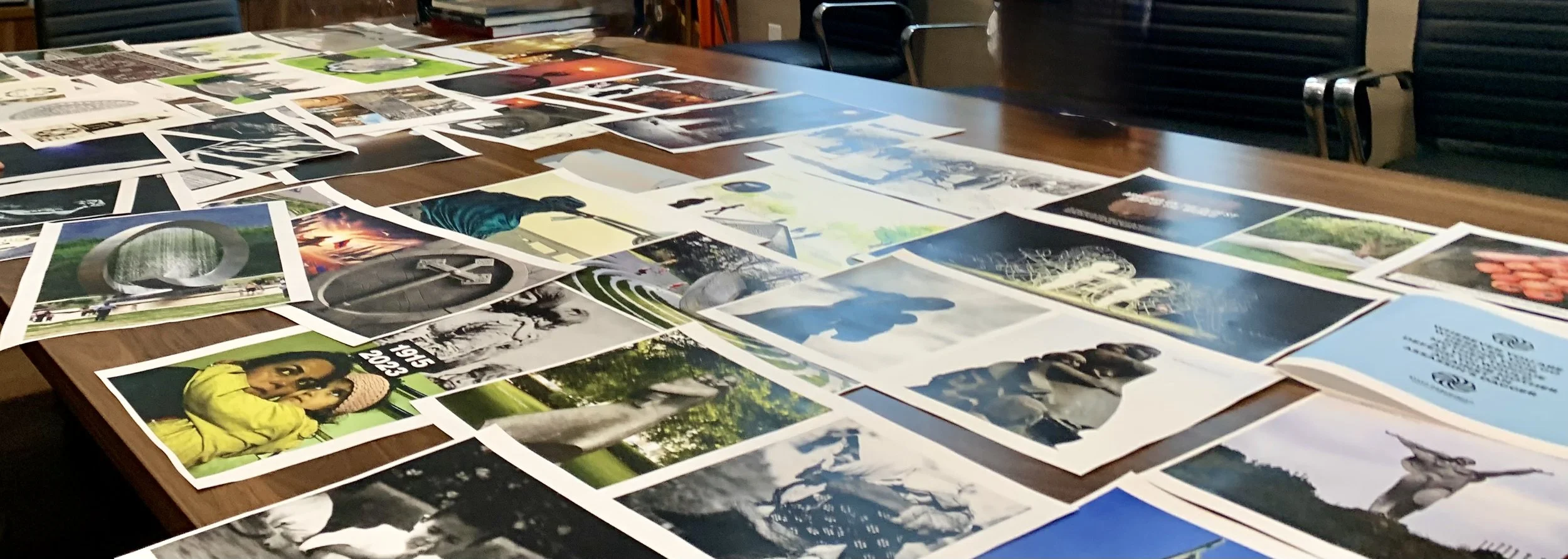
The design committee's concept table, 2024.
The concept the design committee developed rests on three elements. At the center, a mother carrying her child: survival and the continuation of life. Around her, krunks — cranes in flight, the traditional Armenian symbol of longing for a lost homeland. And beneath them, a mosaic rug drawn from Armenian carpet tradition, so that the figure rises from a ground that itself carries memory — a woven record of households, regions, and hands.
The concept emerged from a study the design committee developed in early 2024, which explored three directions for the memorial — Our Spirit, Our Faith, and Our Wounds: the crane and the longing for home; the endurance of Armenian faith; and the deportations of 1915 and the survivors who carried life forward. The chosen design draws all three into a single figure — a mother, her child, the krunks rising around them, on a carpet woven from memory.
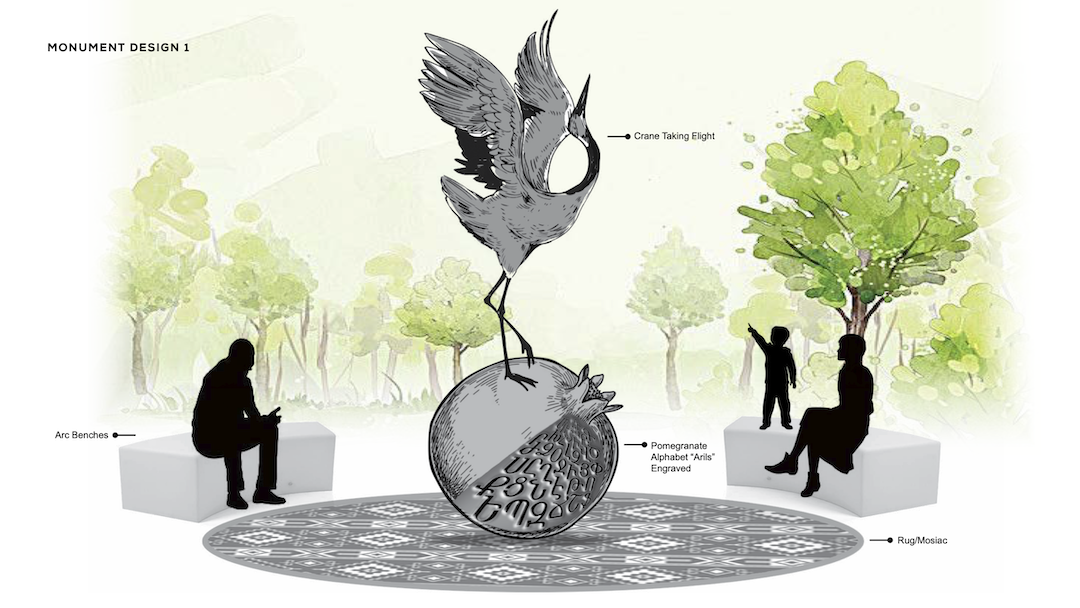
An early concept study by Arlette Madenlian, from the design committee's February 2024 presentation.
In Armenian tradition and song, the krunk — the crane — has long been the bearer of news from the homeland. During the Genocide, when countless Armenians were torn from their families and ancestral lands, the krunk came to embody the longing for word of those from whom they had been separated.
The krunks were proposed twice, independently — within the design committee and by Ara J. Movsesian of the Knights of Vartan — a convergence the Committee took as confirmation that the cranes belonged at the heart of the work, together with the mother and her child.
Together, the mother, her child, and the krunks give enduring expression to loss, separation, remembrance, and the unbroken bond of the Armenian people with their loved ones and their homeland.
Arlette Madenlian has served as the memorial's Creative Director, guiding the concept from its origins through the artist commissions.
"As Armenians, we have a profound connection to the icons and symbols that shape and express our identity," said Ms. Madenlian. "They are deeply embedded in our cultural DNA — powerful reminders of where we come from and who we are. For generations, these symbols have given us a way to carry our culture forward and express our connection to it in ways that feel meaningful and relevant today. We have been here for millennia. We have endured, evolved, and carried our identity forward — and we have no intention of disappearing."
The concept was refined through review with the City of Irvine and approved by the Great Park Board on October 22, 2024 as the memorial's schematic design.
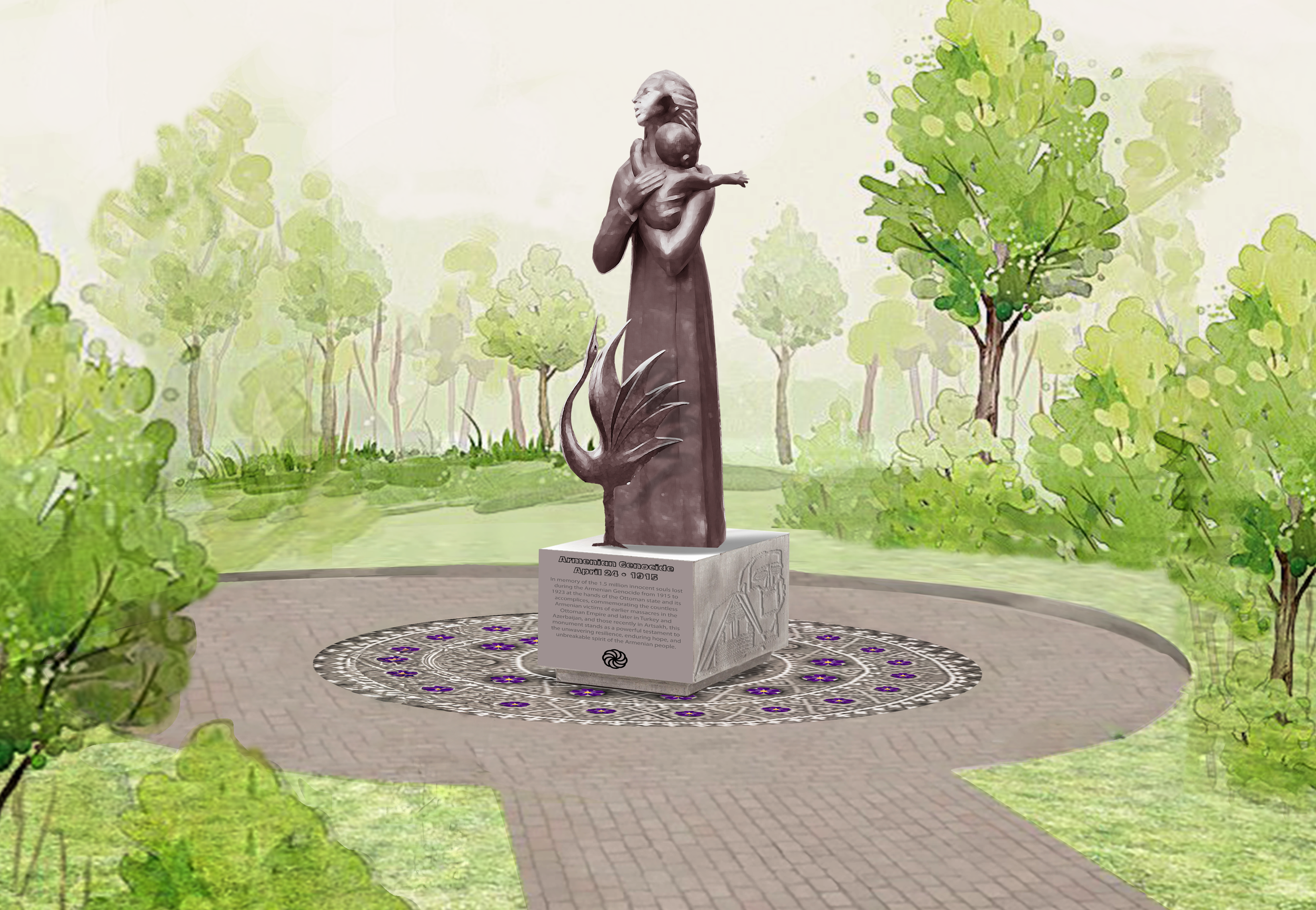
The schematic design approved by the Great Park Board, October 22, 2024.
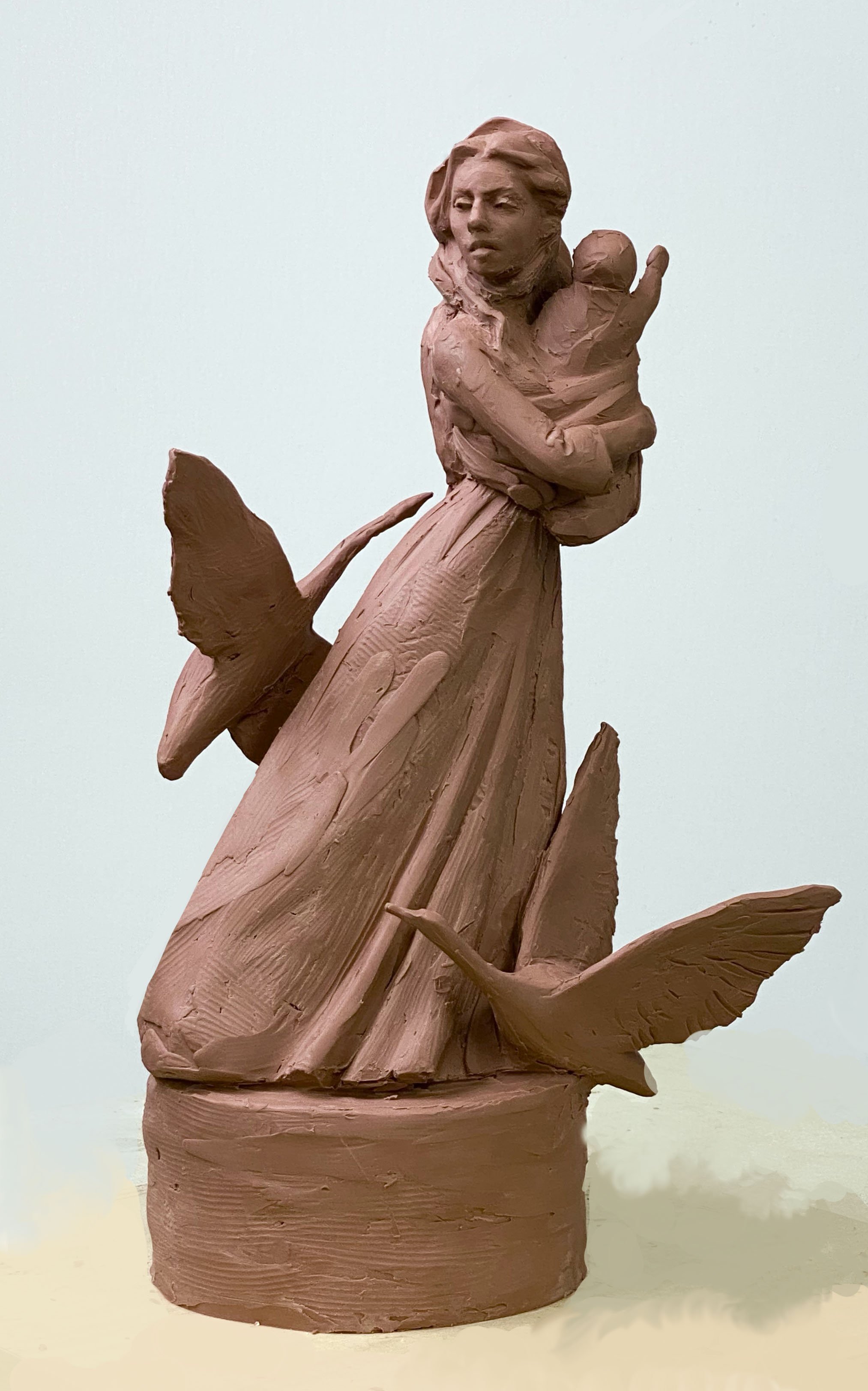
Brittany Ryan's conceptual maquette, unveiled at the 111th Armenian Genocide Commemoration, April 2026.
The schematic design then guided the selection and commissioning of the artists now realizing it: sculptor Brittany Ryan, who developed the approved schematic into the final composition — the krunks multiplying into a small flock in flight around the figure — and whose conceptual maquette was unveiled at the 111th Armenian Genocide Commemoration in April 2026; and mosaic artist Mia Tavonatti, who is designing the twenty-foot mosaic rug. Both are now under full commission, carrying the design committee's vision into bronze and tile.
The memorial will be the first public Armenian Genocide memorial in Orange County. Installation is planned for Spring 2028 in the Heart of the Park at the Irvine Great Park.
The Orange County Armenian Genocide Memorial Committee is a California 501(c)(3) nonprofit. Contributions are tax-deductible to the extent allowed by law. More information is available at ocagm.org.
